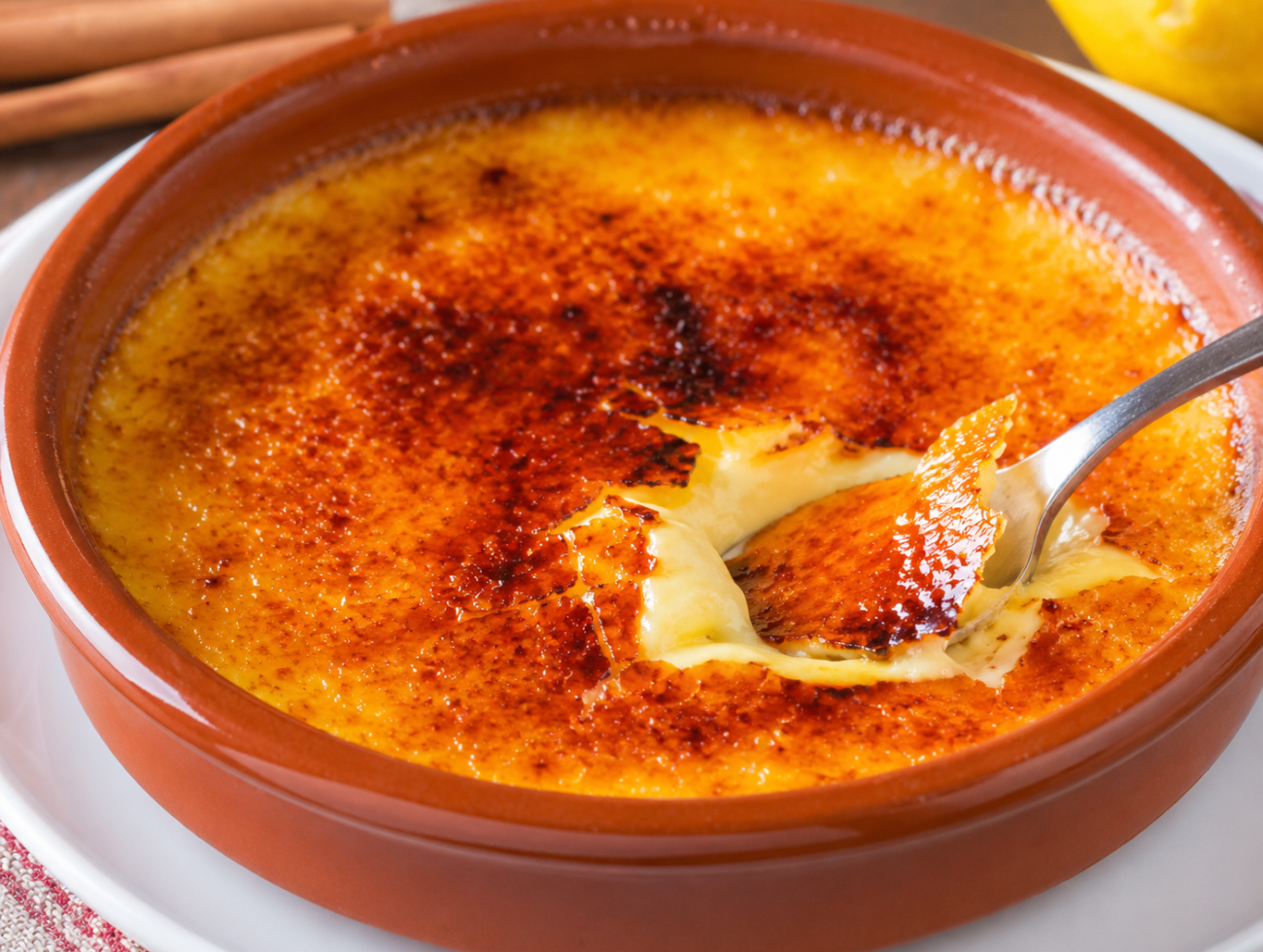
Traditional Catalan cream, known in Spain as crema catalana or crema quemada, is a smooth milk custard scented with cinnamon, lemon peel, and orange peel. Its defining feature is the delicate caramel crust that cracks under a spoon and contrasts with the cool, creamy custard beneath.
Unlike many baked custards, this dessert thickens directly on the stovetop with egg yolks and a small amount of cornstarch. It can be prepared well in advance, chilled in individual dishes, and finished with caramelized sugar immediately before serving.
Why You’ll Love This Recipe
- Cinnamon and fresh citrus peel give the custard a fragrant flavor without overpowering its creamy base.
- A thin layer of caramelized sugar provides a satisfying crisp contrast to the silky custard.
- The dessert is cooked entirely on the stovetop and does not require a water bath or oven.
- The custard can be prepared a day ahead, making it convenient for dinner parties and celebrations.
- Simple supermarket ingredients create an elegant traditional Spanish dessert.
Ingredient Notes
Whole milk
Whole milk gives the custard a rich but lighter character than cream-based desserts. Warm it gently with the citrus peels and cinnamon so it absorbs their aroma without scorching.
Egg yolks
Egg yolks supply color, richness, and a smooth texture. Whisk the warm milk into them gradually to raise their temperature without scrambling them.
Cornstarch
A modest amount of cornstarch helps the custard set reliably while preserving a soft, spoonable consistency. Dissolving it in cold milk prevents lumps.
Citrus peel
Lemon and orange peels add a fresh Mediterranean aroma. Remove only the colored zest and leave behind as much bitter white pith as possible.
Cinnamon stick
A whole cinnamon stick gently perfumes the milk and is easier to remove than ground cinnamon, which would leave visible specks in the custard.
Caramelizing sugar
A fine, even layer of regular granulated sugar creates the best brittle crust. Too much sugar can produce a thick topping that is difficult to break.
Expert Tips
- Infuse the milk gently rather than boiling it vigorously, which can cause scorching and an overly cooked dairy flavor.
- Dissolve the cornstarch completely in cold milk before adding it to the yolks.
- Temper the egg mixture by adding the warm milk slowly while whisking without stopping.
- Cook the custard over moderate heat and reach every corner of the saucepan with the whisk to prevent sticking.
- Remove the custard from the heat as soon as it thickens and begins to bubble because prolonged boiling can damage its smooth texture.
- Strain the mixture before cooking or before filling the dishes if any small lumps appear.
- Chill the custard thoroughly before caramelizing so the torch does not warm the dessert excessively.
- Keep the torch moving and stop once the sugar is evenly melted and amber rather than blackened.
Serving Suggestions
Serve the Catalan cream in wide, shallow earthenware dishes so every spoonful includes plenty of caramelized topping.
Accompany it with fresh berries, orange segments, or sliced strawberries for a lighter contrast.
Pair the dessert with coffee, Spanish dessert wine, or a small glass of sweet Moscatel.
For diners without dietary restrictions, serve it with crisp wafer cookies or a small piece of plain sponge cake.
Storage and Reheating
Cover the cooled custards and refrigerate them for up to 3 days. Store them without the caramelized topping, since the sugar crust becomes soft and sticky in the refrigerator. Add and torch the sugar immediately before serving. Crema catalana should be served cold and does not require reheating. Freezing is not recommended because thawing can cause the custard to separate or become watery.
Frequently Asked Questions
What is the difference between crema catalana and crème brûlée?
Crema catalana is traditionally thickened on the stovetop with milk, egg yolks, and cornstarch and flavored with cinnamon and citrus. Crème brûlée usually contains heavy cream and is baked gently in a water bath.
Why did my Catalan cream develop lumps?
The mixture may have heated too quickly, the cornstarch may not have dissolved fully, or the custard may not have been whisked continuously. Straining it while still warm can remove small lumps.
Can I make crema catalana without a kitchen torch?
Yes. Place the cold ramekins on a tray filled with ice, sprinkle them with sugar, and broil very briefly near the heating element until the sugar caramelizes.
How far ahead can I prepare Catalan cream?
The custard can be made up to 2 days before serving. Keep it covered and refrigerated, then add and caramelize the sugar just before bringing it to the table.
CuisineSpanish, Catalan CourseDessert Yield6 servings NutritionApprox. 285 calories per serving
Ingredients
- 4 1/4 cups (1 liter) whole milk, divided
- 8 large egg yolks
- 1/2 cup (100 g) granulated sugar
- 2 tablespoons plus 1 teaspoon (20 g) cornstarch
- 2 wide strips lemon peel, with as little white pith as possible
- 2 wide strips orange peel, with as little white pith as possible
- 1 cinnamon stick
- 1/4 cup (50 g) granulated sugar, for caramelizing
Instructions
- Pour 3 3/4 cups of the milk into a medium saucepan. Add the lemon peel, orange peel, and cinnamon stick.
- Warm the milk over medium heat until it just begins to simmer, then remove the saucepan from the heat and let the aromatics infuse for 5 minutes.
- Meanwhile, whisk the egg yolks and 1/2 cup of sugar in a large heatproof bowl until smooth and slightly lighter in color.
- Stir the cornstarch into the remaining 1/2 cup of cold milk until completely dissolved, then whisk this mixture into the sweetened egg yolks.
- Remove the cinnamon stick and citrus peels from the warm milk.
- Slowly pour the warm milk into the yolk mixture while whisking constantly to prevent the eggs from curdling.
- Strain the combined mixture through a fine-mesh strainer into a clean saucepan.
- Cook over medium-low heat, whisking continuously and scraping the bottom and corners of the pan, until the custard thickens enough to coat the back of a spoon.
- Continue cooking just until the custard reaches a gentle bubble and a temperature of at least 160°F (71°C), then immediately remove it from the heat.
- Divide the custard among six shallow heatproof ramekins or traditional earthenware dishes.
- Let the custards cool uncovered until no longer steaming, then cover and refrigerate for at least 3 hours, or until completely cold and set.
- Shortly before serving, blot away any moisture from the surface and sprinkle each custard evenly with about 1 1/2 teaspoons of the remaining sugar.
- Caramelize the sugar with a kitchen torch, moving the flame continuously until the topping melts and turns deep golden brown.
- Let the caramel harden for 1 to 2 minutes, then serve the Catalan cream cold with its freshly crisp sugar crust.
Notes
Use only the colored outer portion of the lemon and orange peels. Excess white pith can give the custard a bitter flavor.
Whole milk produces the traditional creamy consistency. Reduced-fat milk can be used, but the custard will taste lighter and may be slightly less silky.
Cornstarch is naturally wheat-free, but choose a package labeled gluten-free when preparing the dessert for someone who avoids gluten.
If a kitchen torch is unavailable, place the chilled ramekins on a baking sheet filled with ice and caramelize the sugar briefly under a very hot broiler. Watch continuously to prevent burning.
Caramelize the topping immediately before serving. Refrigeration softens the sugar crust as it absorbs moisture from the custard.
The calorie estimate includes 1 liter of whole milk, eight egg yolks, 100 grams of sugar in the custard, 20 grams of cornstarch, and approximately 50 grams of sugar for the caramelized topping.
The dietary and intolerance categories describe the written formulation only and do not guarantee the absence of cross-contact.

 Main Dishes