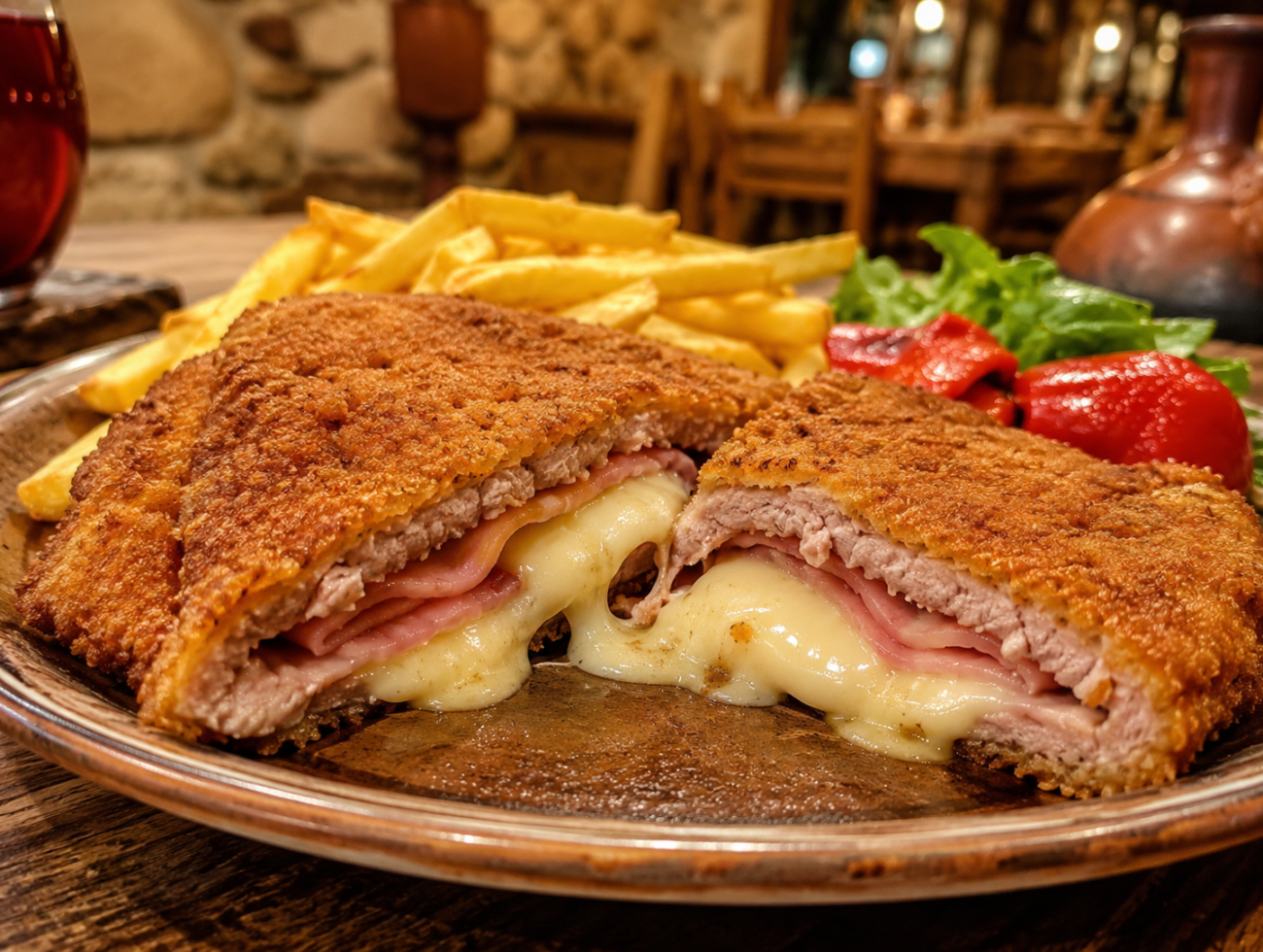
Cachopo is one of the most recognizable dishes of Asturias: a generously sized beef steak filled with serrano ham and melting cheese, then breaded and fried until crisp. Cutting into the golden crust reveals tender meat and a rich, molten center.
This homemade version uses thin butterfly-cut steaks so each cachopo can be sealed around the filling without becoming excessively thick. Fried potatoes and sweet piquillo peppers complete the traditional restaurant-style presentation.
Why You’ll Love This Recipe
- The crisp breadcrumb coating contrasts with tender beef and melted cheese.
- Serrano ham gives the filling a concentrated savory flavor.
- The cheese can be adapted with mild, smoky, or blue varieties according to taste.
- Each large cachopo creates an impressive centerpiece for a Spanish-style meal.
- Fried potatoes and piquillo peppers turn the stuffed steak into a complete main course.
Ingredient Notes
Beef steaks
Use tender, lean steaks cut very thin or opened like a book. Pounding them to an even thickness helps the meat cook before the breading becomes too dark.
Jamón serrano
Spanish cured ham contributes salt and deep pork flavor. Thin slices are easier to enclose inside the steak than thick pieces.
Melting cheese
A mild semi-firm cheese creates the classic flowing center. Edam, Gruyère, Havarti, Monterey Jack, and mild cheddar are widely available options.
Breadcrumbs
Fine plain breadcrumbs create an even traditional crust. Coarser crisp breadcrumbs may be used for additional crunch, but the coating should not become excessively thick.
Piquillo peppers
Sweet roasted piquillo peppers may be placed inside the cachopo or served alongside it. Jarred roasted red bell peppers are a practical substitute.
Frying oil
Use a mild olive oil suitable for frying. Maintaining a moderate temperature allows the beef to cook while the coating turns golden without burning.
Expert Tips
- Pound the steaks between sheets of plastic wrap to prevent tearing and splattering.
- Leave a border around the ham and cheese so the filling does not interfere with sealing the meat.
- Press the edges firmly and use toothpicks only where necessary to prevent the cachopo from opening.
- Apply one complete layer of flour, egg, and breadcrumbs rather than a very thick double coating.
- Use a thermometer to keep the frying oil between 340°F and 350°F (170°C and 175°C).
- Fry in small batches so the oil temperature does not fall sharply.
- Rest the fried cachopo briefly on a rack to preserve its crisp underside.
Serving Suggestions
Serve the cachopo with freshly fried potatoes and roasted piquillo peppers for a classic Asturian-style plate.
Add a simple tomato and lettuce salad dressed with wine vinegar to provide freshness and acidity.
Offer an Asturian Cabrales cheese sauce or cider sauce on the side rather than pouring it over the crisp breading.
A particularly large cachopo may be sliced and shared between two people.
Storage and Reheating
Cachopo is best served immediately while the coating is crisp and the cheese remains melted. Refrigerate leftovers in an airtight container within 2 hours and use them within 3 days. Reheat on a wire rack in a 375°F (190°C) oven for 12 to 18 minutes, or until the center reaches 165°F (74°C). An air fryer may also be used at 350°F (175°C). Microwaving is not recommended because it softens the breading.
Frequently Asked Questions
What cut of beef is best for cachopo?
Thin steaks from the hip, top sirloin, top round, or another tender lean cut work well. Ask the butcher to butterfly the steaks or pound them evenly at home.
What cheese can I use instead of Queso de Oscos?
Use Edam, Gruyère, Havarti, Monterey Jack, or mild cheddar. For a stronger Asturian flavor, replace a small portion with Cabrales or another blue cheese.
How do I stop the cheese from leaking out?
Keep the cheese away from the edges, press the meat closed firmly, bread the entire surface without gaps, and secure loose edges with toothpicks before frying.
Can I prepare cachopo ahead of time?
Yes. Assemble and bread the cachopos several hours ahead, place parchment between them, cover, and refrigerate. Fry them shortly before serving for the best texture.
CuisineSpanish, Asturian CourseMain Course Yield4 servings NutritionApprox. 1150 calories per serving
Ingredients
- 4 thin butterflied beef steaks, about 4.25 ounces (120 g) each, opened like a book
- 4 slices jamón serrano, about 3 ounces (85 g) total
- 8 slices mild melting cheese, about 5.6 ounces (160 g) total, such as Queso de Oscos, Edam, Gruyère, or mild cheddar
- 1 teaspoon fine salt, or to taste
- 3/4 cup plus 1 tablespoon (100 g) all-purpose flour, for coating
- 2 large eggs, beaten
- 2 cups (200 g) plain dry breadcrumbs
- 4 large Yukon Gold or russet potatoes, about 2 pounds (900 g), peeled and cut into fries
- 4 piquillo peppers, drained, optional
- 6 cups mild extra-virgin olive oil or light olive oil, or enough for frying
Instructions
- Place each opened beef steak between two sheets of plastic wrap or parchment paper and gently pound it with a meat mallet until uniformly thin.
- Trim away any tough membrane around the edges so the steaks remain flat during frying.
- Set out three shallow dishes containing the flour, beaten eggs, and breadcrumbs.
- Open one steak on the work surface and season the inside lightly with salt.
- Arrange one slice of jamón serrano and two slices of cheese over one half of the steak, leaving a narrow border around the edge. Add one opened piquillo pepper inside, if desired.
- Fold the empty half of the steak over the filling and press firmly around the edges. Secure any loose sections with wooden toothpicks if necessary.
- Repeat with the remaining steaks, ham, cheese, and optional peppers.
- Coat each stuffed steak lightly in flour, dip it completely in the beaten egg, and cover it evenly with breadcrumbs. Press the crumbs gently against the surface, especially around the edges.
- Heat about 2 inches of olive oil in a wide, heavy skillet to 340°F to 350°F (170°C to 175°C).
- Fry the potatoes in batches until tender and golden, about 6 to 8 minutes depending on their thickness. Drain on paper towels and season with salt.
- Allow the oil to return to temperature, then fry the cachopos one or two at a time for 2 to 3 minutes per side, until the coating is deeply golden and the beef is cooked through.
- Transfer the cachopos to a wire rack or paper towel-lined tray and let them rest for 2 to 3 minutes.
- Remove any toothpicks and serve immediately with the fried potatoes and optional piquillo peppers.
Notes
Ask the butcher for thin butterfly-cut beef steaks suitable for stuffing. Beef hip, top sirloin, top round, or veal cutlets can all work when pounded thin.
Queso de Oscos may be difficult to find in the United States. Edam, Gruyère, Havarti, Monterey Jack, or mild cheddar are practical supermarket alternatives.
Jamón serrano is available in many larger US supermarkets. Prosciutto is the closest convenient substitute when Spanish cured ham is unavailable.
A small amount of Cabrales or another blue cheese can replace part of the mild cheese for a stronger Asturian flavor.
The calorie estimate includes the beef, ham, cheese, realistic amounts of flour, egg, and breadcrumbs retained after coating, four large potatoes, and approximately 1 cup of frying oil absorbed by the full recipe.
Plain breadcrumbs are assumed for the soy-free and sesame-free classifications. Check packaged breadcrumbs, cured ham, cheese, and frying oil labels when strict dietary verification is needed.
For food safety, cook the beef filling thoroughly and ensure the center is piping hot. The USDA recommends a minimum internal temperature of 145°F (63°C) for whole cuts of beef followed by a 3-minute rest.

 Main Dishes